Blogroll

This is default featured post 1 title

Go to Blogger edit html and find these sentences.Now replace these sentences with your own descriptions.This theme is Bloggerized by Lasantha Bandara - Premiumbloggertemplates.com.

This is default featured post 2 title

Go to Blogger edit html and find these sentences.Now replace these sentences with your own descriptions.This theme is Bloggerized by Lasantha Bandara - Premiumbloggertemplates.com.

This is default featured post 3 title

Go to Blogger edit html and find these sentences.Now replace these sentences with your own descriptions.This theme is Bloggerized by Lasantha Bandara - Premiumbloggertemplates.com.

This is default featured post 4 title

Go to Blogger edit html and find these sentences.Now replace these sentences with your own descriptions.This theme is Bloggerized by Lasantha Bandara - Premiumbloggertemplates.com.

This is default featured post 5 title

Go to Blogger edit html and find these sentences.Now replace these sentences with your own descriptions.This theme is Bloggerized by Lasantha Bandara - Premiumbloggertemplates.com.

Showing posts with label child development. Show all posts

Friday, July 29, 2011

The Building Blocks of Learning

Today, we will discuss the key areas of childhood development. What are the most important aspects of our kid's growth?

It may seem fast, but it’s really happening. Our kids are growing, and as they move towards the next stage of development they undergo dramatic transformations in every aspect of maturity.

During this phase, adequate nutrition, environment exposure, and personal experiences help influence the following areas of learning:

Mind: language, problem-solving, concepts and thinking

Body: health, weight gain, motor coordination

Persona: emotions, feeling, social relationships

These interrelated areas are so important that they highly affect a child’s advancement in early learning. It requires great commitment from parents and guardians to keep children safe from physical danger, to provide loving and warm relationships, and to promote confidence when facing challenges. 

To ensure optimal development, it is best to create opportunities for growth in the following aspects of learning:


Cognitive
Cognitive development covers the approaches that children exhibit to better understand and explore the world around them. It explains the ability of a child to solve problems, understand concepts, and develop intuition and nonverbal reasoning.

Language
Language development covers two areas of learning. The first area is called “receptive language,” where a child learns to listen and understand the idea he is being told. The other area is called “expressive language,” where a child learns to not only listen, but to also react by speaking or using sign language. In this domain of learning, children learn to communicate and express their demands, opinions, and feelings the best way possible.

Motor Coordination
Motor coordination pertains to the development and refinement of the large muscles in the body. With this, children learn to move their body effectively to perform motor actions such as walking, sitting, running, and transferring from one body stance to another while maintaining correct posture and pace.

Fine Motor
Fine motor coordination involves the development and refinement of minor or small muscles in the body. An example of this would be the hand.  Fine motor development improves the dexterity of the hand to perform abilities such as eating, writing, picking up objects, and playing.

Personal
Personal development pertains to the improvement of a child’s health and well-being through daily monitoring. It is the ability to complete daily tasks such as brushing their teeth, bathing, feeding, and dressing/undressing.

Social and Emotional
Emotional and communal development refers to the child’s acquisition of trust and security within a relationship, like in families and friends. It is the capability to relate and interact with groups by working together, as well as the ability to maintain close relationships with parents, siblings, and play mates.

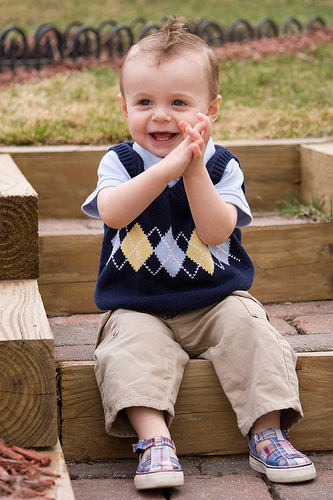
Understanding Your Toddler - Part 1

This is the first part of a 3-article discussion on toddler development. As a parent, it's a wonderful habit to listen to our toddlers and understand their thoughts and emotions. Toddler years are probably one of the most crucial stages of a child's development, thus understanding what your child needs will help him become more expressive and confident throughout the toddler years.


PART I: Understanding Your 1 Year-Old Toddler

  •  At this stage, what is my 1 year-old learning? 
At this stage, your 1 year-old baby will begin to speak. Studies show that 1 year-old babies can normally say around 6 words, but can understand close to 65-70 words. Findings also show that baby girls tend to learn more words at an earlier age than boys. Furthermore, advanced toddlers usually acquire language skills faster. 

  1. Your baby's first words will normally refer to parts of his body, people, and familiar possessions like toys and other objects. 
  2. As his vocabulary increases, your baby will likely add actions to accompany or support his words. Examples of these would be performing hand gestures when saying "come" and "go," or directive movements such as "up" and "down."
  3. Now, as your child moves on from being a 12 month-old to becoming an 18 month-toddler, he will learn new words slowly. Studies say that the average rate is around 4-6 new words per month. Your child will then use these new words regularly or drop them as he tries move on and learn new ones. If you notice your child is no longer using those words he previously learned, don't panic! This is perfectly normal. Even if your child chooses to use newer words in his speech, older words remain in his memory and are not forgotten. 

  •  As a parent, how I can best help my 1 year-old become more advanced in learning?

    1. Encourage your child to play puzzles. A simple 2- to 6-piece puzzles can help improve your toddler's sequencing ability.
    2. Inspire your child to assist you in performing household chores.
    3. Stir your toddler's creativity by helping him build towers of blocks.
    4. Offer them toys that can be emptied and filled.
    5. Encourage your child to draw and scribble by giving him paper and large crayons.
    6. When talking to your toddler, use the proper names of words. Do not approach your child in a "baby talk" manner, as this won't help in his speech development. When your child says "blankie," it's proper for you to say "Blanket, that is right."
    7. Help your toddler in expanding his sentences. When he says "Want water," you say "Do you want to drink water?"
    8. Make it a habit to read storybooks with pictures to your child. It will help him improve his speech and is a great bonding moment too! 
  •  How much will my 1 year-old grow? 
Studies indicate that 1 year-old babies gain an average of 8 ounces and grow an average of 1/4  to 1/2 inch every month. During this stage, his growth rate will begin to bog down. Your toddler will start to develop his muscles and lose baby fat. Help him progress ahead of the rest by giving him the best care and nutrition.
  • What is my 1 year-old feeling?
Now that your toddler uncovered the use of his legs, he will try to walk around more often and explore things on his own. This can both be very exciting and frustrating to your toddler as he will sometimes fall down while trying to discover things around him. He may feel joy, sadness, or anger during this stage. Don't worry, this is perfectly normal. Just let your toddler know that you're there for him to support and guide him in every way. Encourage your toddler to express his feelings and emotions, however do not allow negative behavior such as biting or hitting. 
  1. Your 1 year old will start to develop a sense of self. Words like "me," "my" and "mine" become a common term. 
  2.  If you tell them not to swat the dog, slam his hands on your glass window, or pull his clothes out of the drawer, he may not always listen. Mommies, do not be alarmed! This is just your toddlers way of saying "I'm independent." 
  3. Alongside this increasing sense of self comes his fear of abandonment. Your child will feel very scared when he gets separated from you, and when you disappear, he will lose his self-confidence. This is the stage where separation anxiety on toddlers tend to come into being. This separation anxiety will soon wane during the whole of  toddler years, typically at around 18 months.
              

Twitter Delicious Facebook Digg Stumbleupon Favorites More